|
Getting your Trinity Audio player ready... |
It’s 2025. Somehow, 94.8% of home pages still fail basic web accessibility checks. Users with disabilities still hit walls that shouldn’t exist.
How WebAIM Measured 2025 Web Accessibility Failures
This isn’t just a handful of errors on obscure blogs. WebAIM scanned one million home pages, totalling over 50.9 million distinct accessibility errors. That’s about 51 errors per page, down slightly from last year’s 56.8. These are not hypothetical barriers. These are real-world issues with direct impact on real users. (Source: WebAIM Million Report 2025)
Top 6 Common WCAG Accessibility Errors
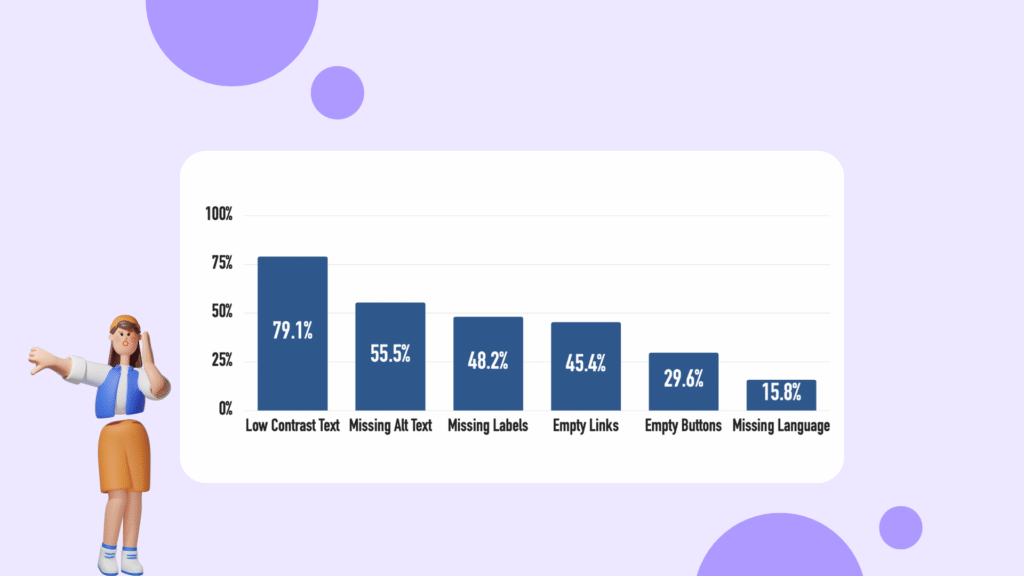
The wild part? 96% of all accessibility errors fall into 6 basic categories, and those 6 have barely changed in 5 years.
These aren’t advanced WCAG failures. They’re entry-level mistakes.
They’re also easy to find, easy to fix, and still everywhere.
Low Contrast Text: The #1 Web Accessibility Failure
Design trend alert: light gray text on white backgrounds still reigns. It looks clean, but if you can’t see it, you can’t use it.
Real-world shopping fail: Product descriptions or pricing in low contrast, especially on sale items, make it unreadable for many users. If someone has to squint or zoom just to read the price, they’ll bounce.
Average violations: 79.1% of homepages
Missing Alt Text: How Poor Image Accessibility Blocks Users
More images, less info. This year, WebAIM found over 58.6 million images across the scanned sites. On average, 11 images per page had missing alternative text, around 55.5% of all issues.
Even worse, 44% of those were linked images; think banners, product carousels, or clickable logos. If you can’t see and there’s no alt text, it’s a dead end.
Real-world shopping fail: Clicking on an image of a product with no label? You’re basically guessing if that’s the shoes you wanted or a banner for a sale that ended last week.
Nearly 1 in 3 images on the web are missing or have questionable or repetitive alternative text, such as alt=”image”, “graphic”, “blank”, a file name, etc., or alternative text identical to adjacent text or the alternative text of an adjacent image.
That’s a massive chunk of content that’s flat-out useless to many users.
Missing Form Labels: The Silent Killer of Accessible Forms
Missing Form Labels – 48.2%
Real-world shopping fail: No label on the “Email” field. No error message when it fails. Forms are where your site either makes money or leaks it. Labels aren’t optional.
Empty Links: The Invisible Navigation Trap
Links that say nothing. Just icons, or worse, just a blank span with href.
Real-world shopping fail: Navigation icons in the header that don’t announce anything to screen reader users. They have to guess what every icon does. Imagine having to guess where a link leads just by trial and error.
Empty Buttons: When Calls to Action Go Silent
A button that says “button.” Cool. But what does it do?
Real-world shopping fail: Add to Cart, but the button is an icon with no label. Screen reader users hear “button” and nothing else. Did it work? Did it fail? Are you still shopping?
Poor Heading Structure: When Accessibility Maps Go Missing
Headings are a map. When they’re missing or misused, the site becomes a maze.
39% had heading skips, and 10% of sites had no headings at all. That’s like printing a newspaper with no headlines.
The ARIA Problem
ARIA is supposed to help. But when it’s thrown in without purpose, it backfires.
- 105 million ARIA attributes were found. That’s about 106 per page.
- Pages with ARIA had double the number of errors (57 vs. 27).
ARIA isn’t the villain; it’s a power tool. Use it wrong and you break things.
Ecommerce Websites: The Worst Accessibility Scores in 2025
Shopping sites ranked dead last for accessibility. Out of all 20+ web categories.
| Category | Avg. Errors | Compared to Average |
|---|---|---|
| Government | 37.2 | −27.0% |
| Personal Finance | 37.7 | −26.0% |
| Education | 47.0 | −7.8% |
| Food and Drink | 50.4 | −1.1% |
| Real Estate | 53.7 | +5.4% |
| Pets | 55.5 | +9.0% |
| Travel | 59.7 | +17.2% |
| Sports | 66.3 | +30.1% |
| Shopping | 71.2 | +39.8% |
Real-world impact:
- Fashion stores with tiny light text, decorative headings, and zero landmarks.
- Pages full of ARIA roles that don’t announce anything properly.
- Homepage carousels that autoplay with no controls, no alt text, and no skip link.
If someone with a disability can’t use your site, it’s not their loss. It’s yours.
See my Accessibility Case Studies for real examples of e-commerce fixes that improved conversions.
Web Accessibility Isn’t a Tech Issue – It’s a Human One
This isn’t about edge cases or nice-to-haves. It’s about real people trying to shop, apply, book, or read and getting locked out.
Accessibility Fixes You Can Apply Today
- Start with a website accessibility audit to pinpoint the real blockers before you redesign or rebrand.
- Run your site through WAVE or axe DevTools.
- Fix contrast.
- Add alt text (real, helpful ones).
- Label your forms.
- Get rid of empty links and buttons.
- Use ARIA only when needed, and correctly.
Small fixes can open big doors. You just have to care enough to make them.